Pick a card –- any card…
And Enjoy Your Sunday.

For the longest time, TV specialty channels have been the success story of our industry. As traditional networks struggled with the problems of trying to satisfy a vast number of demographic and regional viewing habits, the specialties have been able to establish goldmines in their individual niches.
What’s more, unencumbered by the content controls that “censor” network programming, they’ve been able to launch the widely recognized “New Golden Age” of TV programming.
But a few weeks ago, an American study on television revealed the one potentially life-threatening chink in Specialty TV’s armor-plated business model. It relies on repeats.
Now repeats have always been a reality in television. They’ve meant that no broadcaster needs to program original content all year round or 24 hours a day.
Even such Blue Chip Specialties as HBO spend most of their broadcast hours re-running the shows people paid hefty subscriber fees to see in Prime Time as long as a decade ago.
The Canadian Specialty model is even more repeat heavy with the same shows running on tier after tier of every conglomerate’s myriad of channels until their cost has been amortized more often that a one bedroom bungalow in Vancouver.
But this study found that we’re now living in a world with so much new and “Original” programming that nobody has to settle for repeats anymore, so viewership in repeat hours is plummeting.

It’s plummeting further among those who’ve opted for a set-top box like AppleTV and Roku, where new content libraries (many of them free) seem to appear on a monthly basis.
Studios, recognizing that trend, are already licensing their product for Netflix, Amazon Prime and the like, making the viewing windows for their content either limited or completely unavailable to cable channels.
As a result of all this, in the last US Quarter alone, 305,000 Americans cancelled their cable subscriptions, cutting the cord and most likely saving a ton of money without losing either couch time in front of their screen of choice or entertaining content to fill that time.
And now it seems, even cable companies are beginning to free themselves from the bundled world of repeat programming that no longer meets the needs of their customers.
Opting for something they’ve dubbed “Virtual Cable”, DISH Network will begin providing channels via the Internet by the Fall of this year.
Deals already done with major content providers mean that DISH will offer Internet subscribers channels like Disney, ESPN and History without all the lesser (and most repeat heavy) channels they are normally bundled with.
Viewers will no longer have to purchase Fox to view CNN or vice versa; or pay for a bunch of reality channels in order to get TCM or AMC.
It all indicates that the age of Bundling is quickly coming to an end, and maybe even the age of Specialty channels and Networks.
While the CRTC will gather in its windowless rooms next month to contemplate saving our broadcast entities and production finance models in an unbundled future, we’re at the point where you can pay for only what you actually watch and not to finance all those channels that you don’t.
Everyone who works in television understands the Faustian bargain. Your show is only there because somebody needs to sell something.
There’s a guy with a brewery and the people most likely to buy his brew like to flop on the couch after a hard day and look at some cleavage and dinosaurs. You have a show featuring cleavage and dinosaurs. You get green-lit.
If he sells a lot of beer, you get to make more episodes with cleavage and dinosaurs. His beer doesn’t sell, you’re done and pitching an anti-fracking Lesbian time travel show to the CBC.
For as long as there has been television, the “make the advertisers happy to have a successful career” model has been what drives the industry.
And advertisers can be tough. Not only on showrunners but with networks. If the promised audience for their product doesn’t show up, networks have to make up the difference, either by giving the sponsor some of his money back or cramming his ads into every gap in the schedule.
And you wondered why there were ads for adult diapers on kids shows.
But what if the sponsor didn’t care who was watching what?
What if he couldn’t care less about the show he sponsored because he was making money no matter what was on?
What if you could watch anything you wanted just because you’d purchased his beer in the first place?
Carlsberg Breweries is currently testing a product called “Movie Unblock”. The way it works is –- you buy a Carlsberg and pop the top next to the device on which you wish to view something.
A Bluetooth beacon under the cap releases a code the device verifies and unlocks the content you want to see.
Simple.
And nobody needs to sit through a commercial.
Or even make one.
Is the day coming when you don’t need to buy a specialty channel just to see the one show they make that everybody is talking about?
Will there come a time when you don’t need that special sports package to catch your team’s distant road game?
Could we be on the verge of an era where creatives create what they think an audience wants and that audience accesses them directly?
That moment may already have arrived.
GROLSCH BEER - THE MOVIE UNLOCKER BOTTLE from The Bench Cinema on Vimeo.

All my life I’ve been promised a flying car.
When I was a kid, they were featured on the cover of just about every other issue of Popular Mechanics. My dad was certain that by the time I was old enough to get a driver’s license, I’d need pilot certification as well.
But long before I started Driver’s Ed, the Flying car had become more science fiction than automotive fact. And not even serious science fiction. They were considered on a par with the wise-cracking robot maids and auto-hygiene machines of “The Jetsons”.
“Star Wars” speeders gave me brief hope. But even that was dashed when I realized George Lucas was more interested in creating toy franchises than creating the future.
But now I’ve got some hope I’ll soon fly to my destinations rather than drive. For Australian inventor Chris Malloy is close to perfecting the Hoverbike.

At the moment his working prototype is 1/3 scale and available as a high-end drone through a Kickstarter campaign you can access here.
I did my first shoot with a drone a couple of weeks ago. And despite one hard landing that chipped a GoPro housing, the results were spectacular.
And if drones will soon be considered safe enough to deliver Pizzas and books from Amazon instead of just high explosives, the airborne commuter can’t be that far away.
Here’s a taste of what Malloy is doing. I can’t wait.
Enjoy Your Sunday.

Hot day. Cold beer.
It’s a simple formula, internationally understood and embraced everywhere but the UK, a place not especially noted for dealing logically with warm weather.
Probably from lack of experience…
Anyway.
The rest of us relish an icy beverage during the heat of Summer. And advertisers go out of their way to slake that thirst. Beers are showcased on tropical beaches and sidewalk patios. They’re shown bursting out of glaciers and stuck atop snowy mountains. They’re surrounded by babes in Bikinis and guys wearing shades.
But nobody ever drinks them on camera.
That’s because there’s this weird advertising rule which states that alcoholic beverages cannot be consumed on camera.
The first time I was hired to do a beer commercial, this rule was beaten into my head by virtually everybody on set. “Whatever you do, don’t drink the beer! It’s not allowed!”.
Okay. I was a considerate and co-operative performer. Although it seemed like a pretty arcane, straight-laced rule instigated by the temperance lobby or some other despicable authoritarian…
And then I saw what they did to make the beer look so damn icy cold and enticing.
Somebody popped an Alka-seltzer in the glass to make sure it had a head that foamed over the rim.
Somebody else dripped yellow dye in it to achieve the color deemed most appealing to the core demographic.
And somebody else sprayed it with glycerine to replicate real drops of condensation.
Then they did a whole lot more. To the point that when the money shot arrived, you didn’t even want to touch that damn glass, let alone lift it anywhere near your face.
That was decades ago and yet, even when the enhancements aren’t used, you still can’t drink a beer in a commercial.
It’s a taboo that isn’t going away.
Although some people are having fun with it.
Enjoy Your Sunday.
After a week like this last, it’s hard to feel good about the world. It’s harder not to feel desolate about our species and our future.
But we’ve got other sides too. Ones that give us hope and the opportunity to redeem ourselves and show our true humanity.
Among these is one trait too often ignored. Our ability to just be silly.
Silly makes the feeling that things are pointless, pointless itself by doing things which seem pointless, but actually make us relate to each other on the most basic childlike level.
What follows is pointless and silly. But you’ll feel so much better for watching.
Enjoy Your Sunday.
Part One:
Part Two:
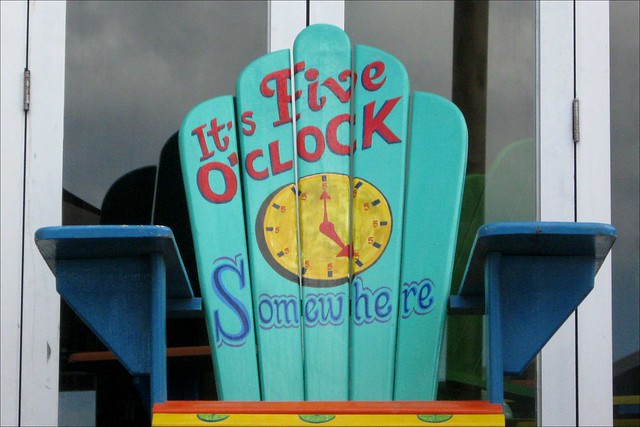
Remember when you were in high school and it got to be the last week of June?
Outside there was sunshine and freedom. But you still had to get through the final exams or classes before they’d let you out. The only thing keeping you going was knowing that the final bell eventually had to ring.
Summer Mondays as an adult are like that. The weekend was great but now you’re back at it. But the sunshine and freedom are still just outside that window.
I make it through by reminding myself that it’s always five o’clock somewhere and eventually my own final bell is gonna ring.
Here’s some more of that same Cowboy Logic to give you hope and get you through the rest of your day.

Given the post title, you well might think I’ve stooped to “link-baiting”. But I’m not. There’s a serious point to be made here.
To begin with, I’ve always believed that nine year olds make the best movie marketers. Part of this belief comes from having met several successful people who market films. And part results from experiencing the wonderful imaginations of actual nine year olds.
Spark your average child of nine and they can go for days.
“Hey Kid, what do you think the new “Star Wars” movie will be like?”
That’s all it takes and within hours you’re inundated in pitches, fridge pictures and video repurposed from every previous “Star Wars” movie.
And this is what movie marketers do as well. From the moment a film is green-lit, they begin the process of igniting the dormant nine year old in all of us. For any film to succeed it needs to become an essential can’t miss moment in our lives.
And while I understand that logic from a business perspective, part of me still treasures the nine year old me, who walked into movie theatres not knowing what to expect beyond the images from the poster and lobby cards –- and was repeatedly completely blown away by the unexpected story that unfolded onscreen.
I get to relive that experience almost weekly thanks to Netflix, whose libraries are full of movies that escaped my radar for one reason or another. I see a story idea, a star I like or an image that catches my attention and am taken into a world where I have no preconceptions or expectations.
There’s a reason movie theatres were once called “Dream Palaces”. Yes, they were places where you went to experience things that didn’t exist in your real life. But, like sleep, when those lights went down, you really didn’t know what dreams awaited.
These days there’s little chance of avoiding what your average tent-pole blockbuster holds in store. Studios leak stories from the first script read through to the red carpet premiere and film nerd websites plaster every cell phone picture or video that they can get their hands on. Even if they are only costumes or props.

This week, one famous director posted about being brought to tears by a visit to the set of “Star Wars VII” implying that the geek magic was that overwhelming –- and maybe suggesting that nobody had jumped to get him a Cappuccino and he suddenly realized he really wasn’t all that and a bag of chips.
Not too long ago, I stepped out a studio door, colliding with a videographer recording a breathless update from a director fresh from a gruelling 14 hour day on set. It was for the daily “private web feed” that had been promised to fans of the multi-sequel franchise he was helming.
I remember wondering what surprises would be left for those subscribing to the feed after getting these daily descriptions of what had transpired onset.
Yeah, it was another revenue stream for the studio and kept the marketing pot bubbling. But sometimes that soup gets overcooked.
My own theory on the current downturn in box office numbers is that we’re being oversold. When movie posters work hard to remind us of previous films in the genre and the trailers repeat the same beats and CGI explosions, deep down we start feeling the dream we’re told we must experience is a recurring one.
So instead of following the marketers, I think we should all go back to following the imaginations of those real excited nine year olds who make up their own leaked set footage.
And then what you get in the theatre will still be a surprise.
Enjoy Your Sunday.


The purpose of the original Hollywood “Gatekeepers” was to make sure that the studios, the networks and even publishing houses, newspapers and magazines controlled the creative agenda.
Sometimes that was done to protect the financial or genre interests of a particular studio or network. Disney did family pictures. MGM was the only place for musicals, etc.
Sometimes their role was to protect a basic narrative, encouraging the creation of films that didn’t make too many waves. America was good. The cowboy was a wholesome symbol of independence. A woman’s place was in the home. No kissing someone of another race. Gay people didn’t exist.
Communist even socialist views could lead to blacklists. Writers creating anti-heroes were discouraged. Nothing in a script could intrude on the basic “America the beautiful” storyline or disturb either Mom, Pop, Buddy or Sis when they gathered around the tube during Prime Time. Certainly nothing that might make them question the basic narrative in the first place.
A lot of us feel the era of the Gatekeeper is over. With the advent of crowd-funding, virtually anybody can make any movie or TV show they like nowadays. The Internet provides world-wide access to niche audiences for any subject or point of view.
It’s a brand new day for Creatives.
Or is it…?
Last weekend, documentary filmmaker Dinesh D’Souza released his film “America”, a flashy theatrical feature produced by Gerald R. Molen, best known for producing “Rainman”, “Jurassic Park” and “Schindler’s List”.
In limited release, the film grossed $4 Million in its first weekend. It’s release was accompanied by the publication of D’Souza’s book of the same title, currently #3 on the Amazon bestseller list, with an average rating of 4.6 out of 5.
But it seems that despite the popularity of both items, a new generation of “Gatekeepers” has stepped in to make sure it does not reach a wider audience.
If you check out the film on Rotten Tomatoes to see if it might be to your liking, you will see this:
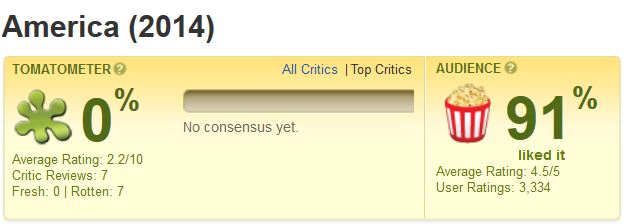
Unusual, isn’t it? A film that 91% of its paying audience liked but not one film critic thinks you should waste your time watching.
It should be pointed out that 17% and 49% of this same group of critics felt you’d get your money’s worth from the new “Transformers” and latest “The Amazing Spiderman 2” respectively.
So is this about reviewing a movie on its merits or is it about something else?
The situation of the book is even more bizarre. While it’s flying out the door at the world’s #1 bookseller, the #2 vendor, Costco, is taking it off the shelves.
On July 1, Costco issued a “pull-order” requiring all stores to make it unavailable as soon as possible. Meanwhile, although its sales should have landed it #8 on the venerated New York Times Best Seller list, it went unlisted.
Did Costco suddenly decide it wasn’t in the business of making money? Does Costco censor books? Does the New York Times?
I can’t answer that. Because nobody at Costco is talking. And the Times assured the “America” publisher it’s sales position will be reflected –- in two weeks.
Whatever is going on, it appears that we have not rid ourselves of the Gatekeepers. They’ve simply moved to a new position in the distribution system.
You can tell whatever story you want these days. Share whatever world view you wish. But it seems the Gatekeepers will still do their best to make sure nobody else sees it.
They still control the narrative.

For all the blood, sweat and tears screenwriters expend constructing a story and filling it with memorable characters, the audience’s dynamic link with a film comes from the director.
Oh, they’re drawn by the stars too and seeking something from the genre or the theme. But let’s set that “collaborative medium” thing aside for a moment and admit that in the final analysis it’s the Director who grabs them by the balls –- or whatever.
Screenwriter Peter Stone once quipped that directing was “as hard as falling down and chipping a tooth”. And since Stone mostly wrote bullet (and director) proof scripts, you can forgive him for thinking the craft came down to the Directing 101 assertion that a film is nothing but shots and cuts.
But every great director has one shot or cut that others may copy or emulate but they never master. And even utterly talentless helmers can come up with one that keeps them working for life.
Spielberg is known for the one shot scene. Scorcese always finds a moment of utter silence to nail your attention. Peckinpah was the master of Slo-Mo while Hitchcock had moves that turned any scene sinister.
And Michael Bay has patented “Bayhem”.
Now, nobody hates Michael Bay movies as much as I do. But you gotta give the guy his due. When it comes to filling a frame and overwhelming your senses (maybe beating them to a pulp is more accurate) nobody does it better.
Maybe the reason his movies are so bad is because there simply isn’t room for a story amid everything else that’s going on. Although, I’ve often wondered what would happen if you linked him with a screenwriter suffering from the same multi-level form of ADHD. Maybe Tarantino or Charlie Kaufman.
For a close look at and explanation of how Bayhem works, I place you in the gifted hands of “Every Frame A Painting” host Tony Zhou.
No matter how you cut it, Michael Bay has mastered “that shot”.
Enjoy Your Sunday…
July 4th and the turn of our neighbors to the South this week to burn weenies, get drunk and handle explosives.
The USA is going through a rough patch right now. Fragmented, confused, dissonant and more than a little broke. They deserve a party.
But I know they’ll come back stronger and more united than ever. They always do. And the rest of us need them to.
That built in resilience is mostly because they began with a clear vision of who they were and what they wanted to be.
Happy July 4th, American readers. Never forget where you come from and how you got here…

Canada Day Bucket List:
1. Tim Horton’s (Check)
2. Maple Donut (Check)
3. Put up the Flag (Check)
4. Play some Nickleback for the Neighbors (Check)
5. Throw the Dog in the Ocean (Check)
6. Blue Jays Game (Check + We Won!!!)
7. Get Drunk (Check)
8. Burn Burgers and Weenies (Check)
9. Get Drunker and Sing “Oh Canada” really loud (Check)
10. Set off Explosives in the backyard (Awesomely Accomplished!)
Tomorrow’s checklist will include a meeting with the local constabulary and the Fire Marshal, rounding up the currently scattered neighborhood dogs, a visit to the burn unit –- and considering going on the wagon for a few days.
Other than that…
Best Canada Day Evah!!!


